Imagine you’ve found the perfect location for a new EV fast-charging station.
The site has excellent traffic, strong charging demand, and enough space for multiple DC fast chargers.
But there’s one problem: the available grid capacity isn’t enough to support your planned charging power.
Upgrading the transformer or expanding the grid connection could involve significant costs and months of waiting.
For many EV charging operators, this is one of the biggest obstacles to building new charging infrastructure.
But what if your charging station could store electricity when demand is low and release it when multiple vehicles need fast charging?
That’s exactly what battery-buffered EV fast charging makes possible.
By combining Battery Energy Storage Systems (BESS), DC fast chargers, and intelligent Energy Management Systems (EMS), charging operators can deliver higher charging power during peak demand without relying entirely on the grid.
And this approach is already changing how EV charging stations are being designed.
A Real-World Example: Battery-Buffered EV Charging in New York
In January 2026, XCharge North America and Energy Plus announced plans to develop a battery-backed EV charging depot in Williamsburg, Brooklyn, New York.
The announced project features:
44 battery-integrated GridLink charging units
88 EV charging parking spaces
Approximately 9.46 MWh of planned battery storage capacity
Charging equipment configurations offering up to 300 kW
What makes this project particularly interesting isn’t simply its size.
It’s the way battery storage is being integrated directly into charging infrastructure.
Instead of drawing all the electricity required for fast charging directly from the grid at the moment vehicles arrive, the battery systems can store energy in advance and release it when charging demand increases.
This helps reduce the station’s instantaneous dependence on grid power.
For charging operators facing limited grid capacity, this model offers an alternative worth evaluating.
The project also reflects a broader industry trend: EV charging infrastructure is increasingly becoming an integrated energy management business rather than simply a network of charging points.
Why Limited Grid Capacity Is a Major Challenge for EV Fast Charging
As EV adoption increases, charging stations need to support more vehicles and higher charging power.
However, the electrical infrastructure at many commercial locations was not originally designed for high-power DC charging.
Consider a commercial charging station planning to install two 120 kW DC fast chargers.
The combined maximum charging output could reach 240 kW.
But what happens if the site only has 100 kW of available grid capacity?
Traditionally, the operator might need to upgrade the transformer, request a larger grid connection, or reduce charging power.
Each option presents challenges.
Grid upgrades can require additional capital investment, utility approvals, and construction work.
Reducing charging power may affect the customer experience and limit the number of vehicles served.
Battery-buffered charging provides another option: use stored energy to supplement the grid during charging peaks.
This can help operators make better use of existing electrical infrastructure while maintaining greater flexibility in charging station design.
How Does Battery-Buffered EV Fast Charging Work?
The principle is simple.
Think of a BESS as a large energy reserve for your charging station.
When electricity demand is low, the battery stores energy from the grid or available solar PV generation.
When multiple vehicles arrive and require fast charging, the battery releases stored electricity to support the chargers.
An intelligent EMS coordinates the energy flows between the grid, battery storage, solar PV, and charging equipment.
A Simple Example: 100 kW Grid Power Supporting 240 kW Charging Demand
Imagine a charging station with:
100 kW of available grid power
Two 120 kW DC fast chargers
An appropriately sized BESS
When both chargers operate at full output, the charging demand reaches 240 kW.
In a simplified scenario, the grid supplies 100 kW, while the battery provides approximately 140 kW of additional power, excluding system losses.
This allows the charging station to temporarily deliver more charging power than the grid connection alone could support.
However, battery storage has limited energy capacity.
The actual charging duration depends on battery capacity, discharge power, charging frequency, system efficiency, and the time available to recharge the battery.
That’s why proper system design is essential.
4 Business Benefits of Battery-Buffered EV Charging
1. Reduce Dependence on Expensive Grid Upgrades
Increasing grid capacity can be one of the most expensive and time-consuming parts of developing a high-power charging station.
In some locations, operators may face transformer upgrades, new electrical infrastructure, or extended utility approval processes.
By using BESS to manage charging peaks, operators may be able to reduce or defer certain grid upgrades.
This can make locations with limited electrical capacity more attractive for EV charging development.
Whether an upgrade can be avoided depends on local utility requirements and site-specific engineering.
2. Manage Peak Electricity Costs
High-power EV charging can create significant peaks in electricity demand.
In markets with demand charges or time-of-use electricity pricing, these peaks can increase operating costs.
Battery storage allows operators to manage when electricity is purchased and when stored energy is used.
For example, the BESS can charge during lower-cost electricity periods and discharge during peak charging demand.
This creates opportunities to reduce peak grid import and optimize energy expenses.
Actual savings depend on local tariffs, charging utilization, battery efficiency, and operating costs.
3. Improve Solar Energy Utilization
Battery-buffered charging becomes even more valuable when combined with solar PV.
Commercial parking facilities, logistics centers, factories, and fleet depots may have suitable rooftop or carport space for solar generation.
A solar-storage-EV charging system can use solar electricity to support charging demand and store suitable excess generation for later use.
The result is a more flexible energy ecosystem:
Solar PV + BESS + DC Fast Charging + EMS
This approach can improve on-site solar utilization, reduce dependence on grid electricity, and support more intelligent energy management.
4. Support Future Charging Station Expansion
Charging demand is rarely static.
A commercial charging site may begin with two chargers and expand as EV adoption increases.
A logistics company may gradually electrify more vehicles.
Modular energy storage solutions can provide additional flexibility for future expansion, depending on the system architecture.
By considering battery storage during the early planning stage, operators can better prepare their charging infrastructure for changing demand.
Where Does Battery-Buffered EV Charging Make the Most Sense?
Battery-buffered charging is particularly worth considering in applications where high charging power is required but grid capacity is limited.
Public EV Charging Hubs
Public charging stations and highway service areas often need to serve multiple vehicles within short periods.
Battery storage can support charging peaks and help operators manage available grid capacity.
Commercial Fleet Depots
Delivery fleets, logistics companies, and commercial vehicle operators may experience concentrated charging demand when vehicles return to their depots.
BESS can help manage these charging peaks and coordinate energy use with fleet schedules.
Shopping Centers and Commercial Parking Facilities
Shopping malls, hotels, office buildings, and parking operators may want to install fast chargers without significantly increasing their electrical connection capacity.
Battery-buffered charging offers an additional option for evaluating these projects.
Solar-Powered EV Charging Stations
For sites with solar PV, battery storage can help balance electricity generation and charging demand.
This is particularly relevant for commercial solar-storage-charging projects.
Emerging EV Charging Markets
In Brazil, Latin America, the Middle East, and Africa, charging infrastructure developers may encounter varying grid conditions, electricity tariffs, and utility connection requirements.
Battery-buffered charging can be an attractive option for certain grid-constrained projects, provided the technical and commercial conditions are suitable.
Is Battery-Buffered EV Charging Worth the Investment?
Adding battery storage increases the initial equipment investment.
Therefore, the financial value of a battery-buffered charging station should be evaluated against a conventional charging infrastructure design.
Several factors influence the business case:
Grid upgrade costs: How much would it cost to increase the available grid capacity?
Charging utilization: How many vehicles are expected to charge each day?
Electricity tariffs: Are there demand charges or significant peak/off-peak price differences?
Battery operating costs: What are the expected efficiency losses, maintenance requirements, and degradation?
Future expansion: Will the site require additional chargers or higher power in the future?
A charging station with occasional short power peaks may have a different business case from a heavily utilized fleet depot.
The best approach is to compare project costs and expected performance using realistic charging demand and local electricity tariff assumptions.
Two Approaches to Battery-Buffered EV Charging
Different charging projects require different system architectures.
All-in-One Solar-Storage-EV Charging Systems
An All-in-One system integrates battery storage, EV charging equipment, and energy management into a coordinated platform.
This approach can be attractive for commercial charging stations, fleet depots, and charging hubs where integrated equipment and simplified system coordination are priorities.
Separate BESS and DC Fast Chargers
For larger or customized projects, operators may prefer a separate commercial BESS connected to one or more DC fast chargers.
This architecture provides flexibility in selecting charging equipment, battery capacity, and energy management configurations.
It may be suitable for retrofitting existing charging stations or developing customized charging infrastructure.
Both approaches require appropriate electrical design and validated equipment compatibility.
Recreen Energy: Integrated Solar-Storage-EV Charging Solutions
At Recreen Energy, we believe the future of EV charging is not only about installing more powerful chargers.
It’s about combining charging power, battery storage, and intelligent energy management into a smarter energy solution.
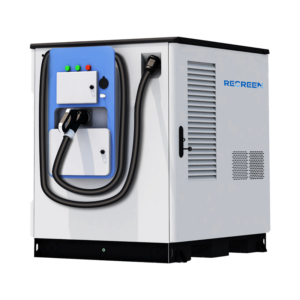
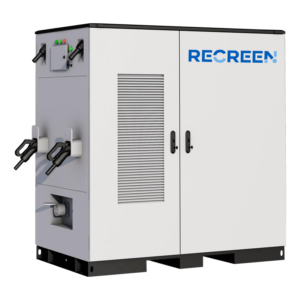
We provide integrated Solar-Storage-EV Charging Systems for different commercial applications, from compact charging installations to higher-power charging hubs.
Our All-in-One Solar-Storage-EV Charging Solutions
| Integrated Solution | Battery Capacity | Charging Configuration |
|---|---|---|
| 120 kW All-in-One | 209 kWh | DC fast charging |
| 320 kW All-in-One | 482 kWh | Dual-gun charging |
| 400 kW All-in-One | 625 kWh | Dual-gun charging |
| 480 kW All-in-One | 1 MWh | Four-gun charging |
These solutions can be considered for applications including:
Commercial EV charging stations
Public fast-charging hubs
Logistics and fleet charging depots
Solar-powered EV charging facilities
Grid-constrained charging locations
By integrating BESS with EV charging equipment and energy management, these systems can help operators manage charging peaks and make better use of available electrical infrastructure.
Customized Solar-Storage-EV Charging Solutions
Every charging project has different requirements.
Some locations have limited grid capacity. Others need to charge multiple vehicles simultaneously or integrate existing solar PV systems.
Beyond our standard All-in-One product range, Recreen Energy also offers customized solar-storage-EV charging solutions based on specific project requirements.
We can work with EPC contractors, charging operators, and system integrators to evaluate:
Battery storage capacity and charging power
Number of charging connectors
Available grid capacity and peak demand management
Solar PV and battery integration
Energy management and communication requirements
Electrical architecture and future expansion needs
Our goal is to help customers select a technically appropriate and commercially practical solution rather than simply offering a standard equipment configuration.
Frequently Asked Questions About Battery-Buffered EV Charging
What is battery-buffered EV charging?
Battery-buffered EV charging uses a battery energy storage system to supplement grid electricity during charging peaks. The battery stores energy during lower-demand periods and releases it when additional charging power is required.
Can DC fast chargers operate with limited grid capacity?
Yes, in suitable applications. An appropriately sized BESS can provide additional power for limited periods. Actual performance depends on battery discharge capability, available energy, and charging demand.
Can BESS eliminate the need for a transformer upgrade?
In some projects, battery storage may help avoid or defer certain upgrades. However, local utility requirements, site infrastructure, and electrical design must be evaluated.
Can battery storage reduce EV charging operating costs?
It can help manage peak electricity demand and shift electricity consumption to lower-cost periods. Actual savings depend on local tariffs, charging utilization, and system operating costs.
Can solar panels and battery storage work together at an EV charging station?
Yes. Solar PV can supply electricity directly or charge the BESS when suitable generation is available. An EMS coordinates energy flows between solar generation, battery storage, grid power, and charging demand.
What size BESS is needed for an EV fast-charging station?
The required battery capacity depends on charger power, available grid capacity, charging duration, simultaneous demand, and battery recovery time. A project-specific assessment is required.
Is an All-in-One system better than a separate BESS?
Both approaches have advantages. All-in-One systems can simplify equipment integration, while separate BESS configurations may offer greater flexibility for customized or retrofit projects.
The Future of EV Charging Is About Smarter Energy Management
The next generation of EV charging infrastructure will not be defined by charging power alone.
Grid capacity, electricity costs, renewable energy integration, and operational flexibility will increasingly influence how charging stations are developed.
Battery-buffered EV fast charging provides an alternative for projects facing limited grid capacity.
By storing energy when it is available and delivering additional power during charging peaks, BESS can help operators make more effective use of existing electrical infrastructure.
For charging station developers, EPC contractors, and fleet operators, the key question is no longer simply:
“How powerful should our chargers be?”
It is also:
“How can we deliver the charging experience our customers need with the grid capacity available at our site?”
Planning an EV Charging Project with Limited Grid Capacity?
Whether you’re developing a commercial charging station, a fleet depot, or a high-power EV charging hub, Recreen Energy offers integrated solar-storage-EV charging solutions and customized BESS configurations.
Explore our 320 kW / 482 kWh dual-gun, 400 kW / 625 kWh dual-gun, and 480 kW / 1 MWh four-gun All-in-One systems, or discuss a customized solution for your project.
Share your available grid capacity, planned charging power, project location, and expected charging demand.
Let’s explore how battery storage and intelligent EV charging can work together for your business.