How Recreen Energy designed a reliable commercial solar and battery storage solution with integrated hybrid inverters, fast STS switching, modular redundancy and future EV charging expansion.
Project Overview
What happens to a commercial business when the utility grid suddenly fails?
For retail stores and other commercial facilities, an unexpected power outage can interrupt daily operations, affect essential equipment and create unnecessary business losses.
That is why a successful commercial energy storage project should deliver more than battery capacity. It should also consider power supply reliability, grid-to-off-grid switching speed, system redundancy and long-term energy management.
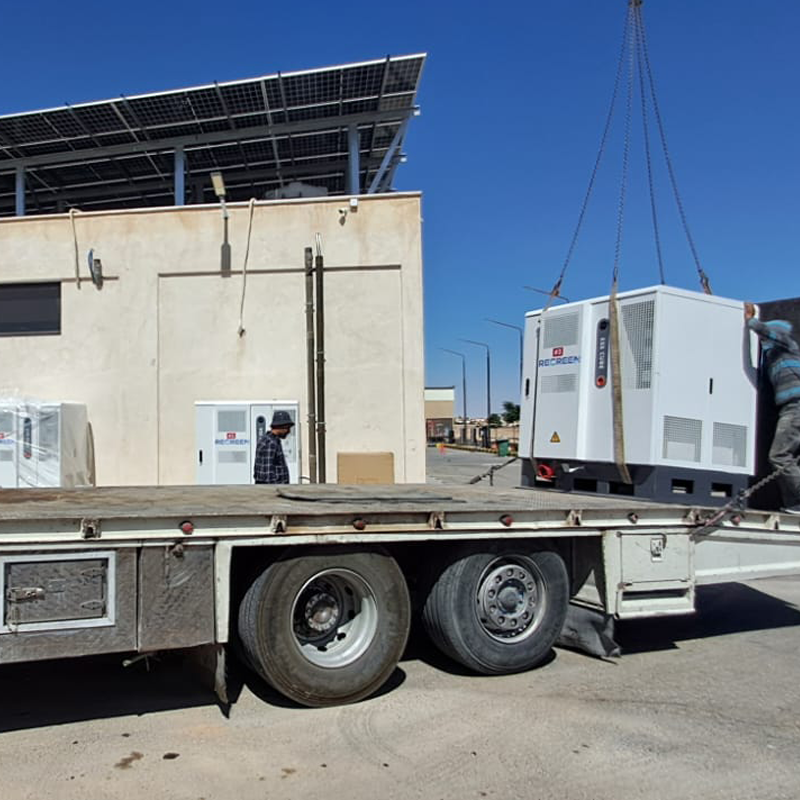
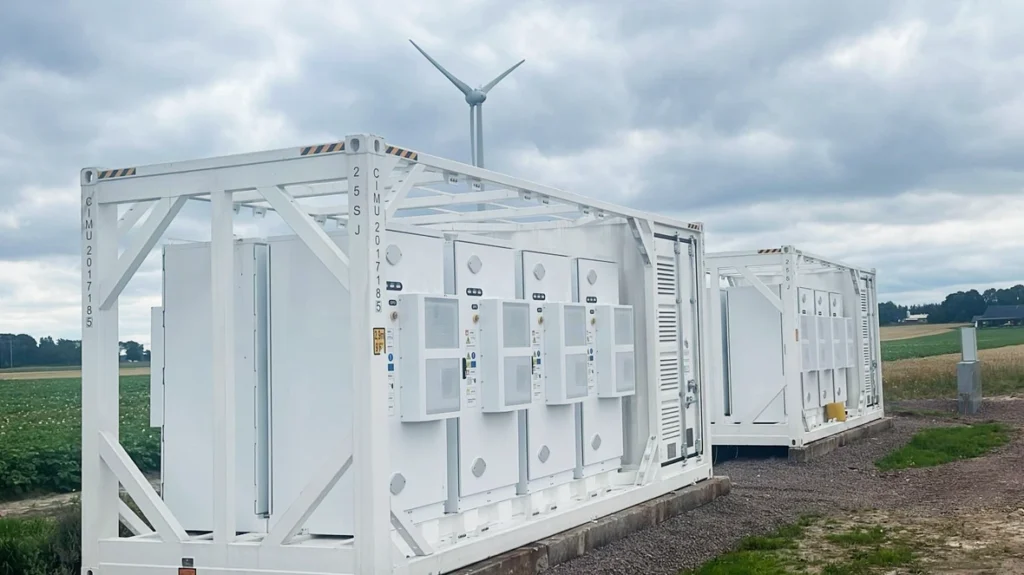
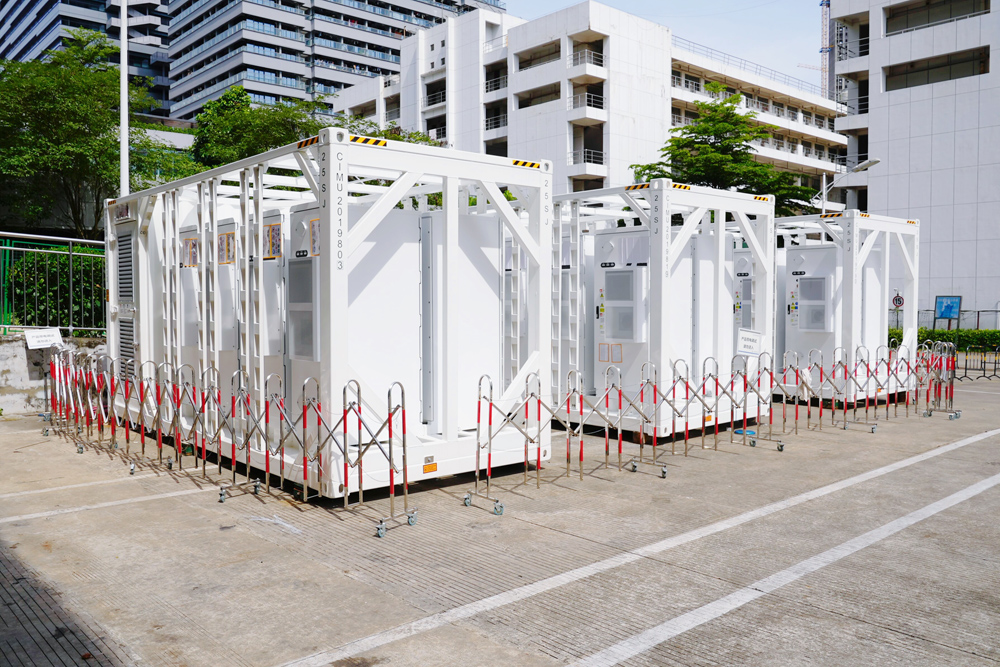
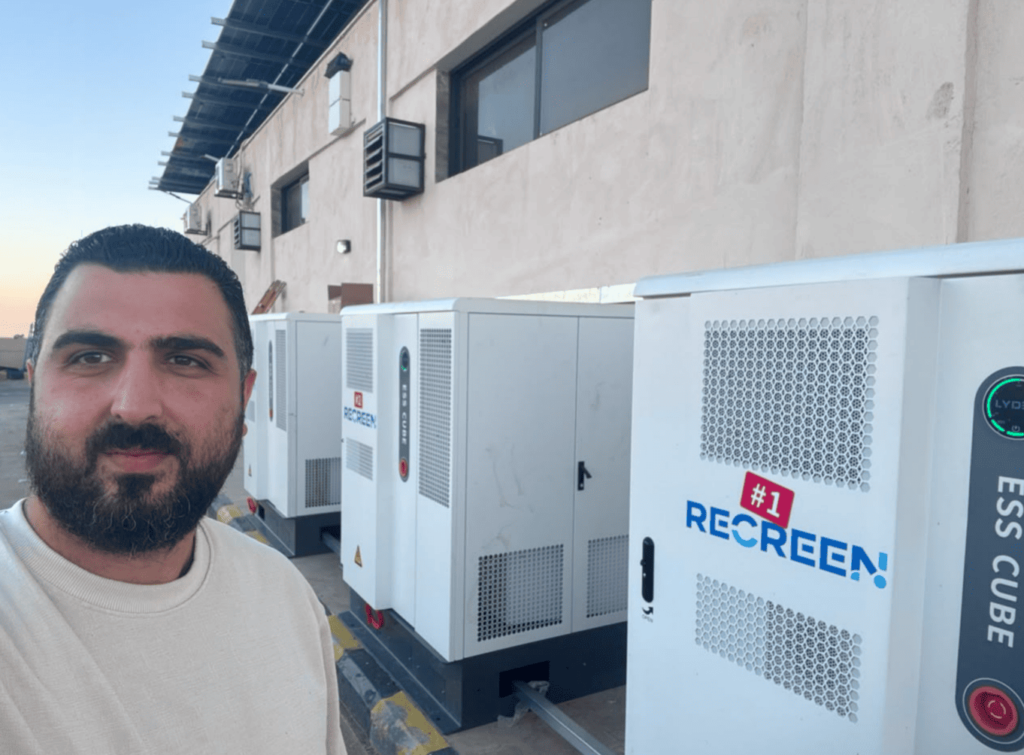
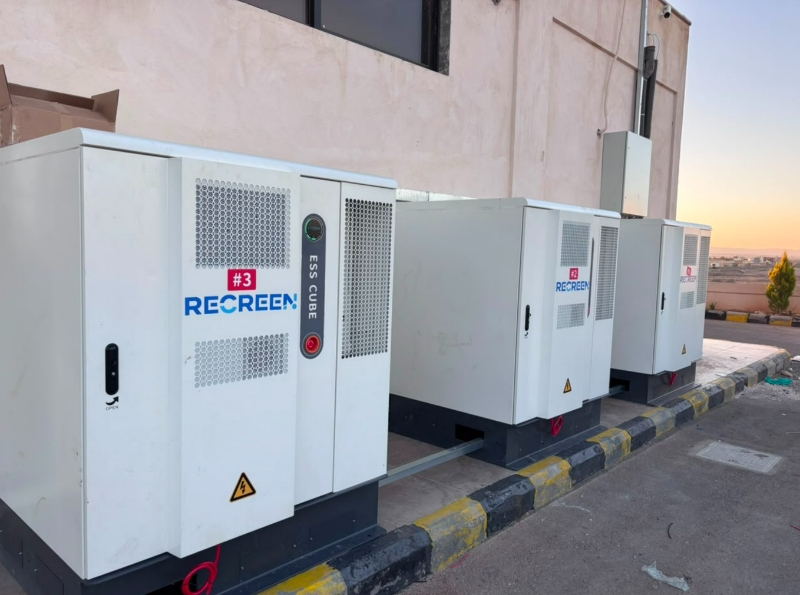
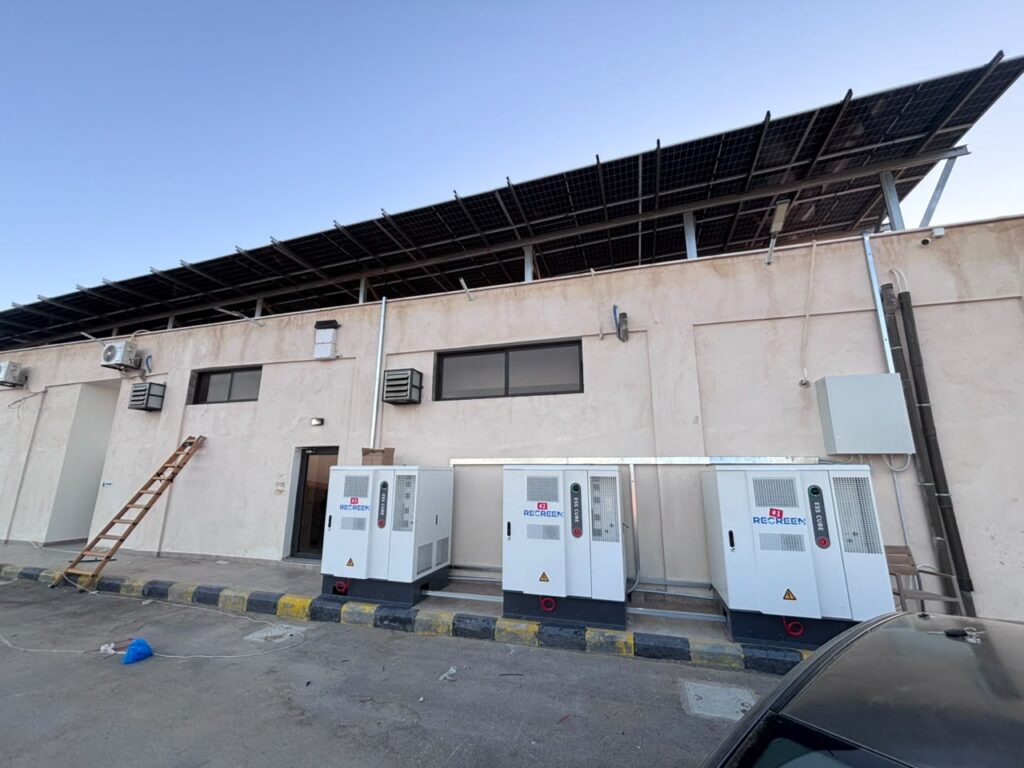
In Jordan, Recreen Energy supplied a 150kW/651kWh commercial and industrial battery energy storage system (C&I BESS) for a retail store, integrated with a 250kWp solar PV installation.
The system consists of three 50kW/217kWh hybrid ESS units. Each cabinet integrates a 50kW hybrid inverter with built-in MPPT functionality and a Static Transfer Switch (STS) supporting 10ms on-grid/off-grid switching.
The customer’s existing electrical load is approximately 90kW. Instead of selecting a system based solely on this load, Recreen recommended a 150kW modular configuration to provide additional power capacity and improve system redundancy.
The operating strategy is equally important: solar PV and battery discharge support the store’s daytime electricity demand, while the batteries recharge from the utility grid at night when consumption is lower.
The customer also operates several EV charging stations near the store and plans to expand battery storage capacity to support future charging demand.
This project demonstrates how integrated hybrid energy storage can combine solar generation, fast backup power switching, flexible energy management and future scalability in one commercial solution.
Project at a Glance
| Project Details | Spezifikationen |
|---|---|
| Project Location | Jordan, Middle East |
| Anmeldung | Retail Store / Commercial Energy Storage |
| Solar PV Installed Capacity | 250kWp |
| Total BESS Rated Power | 150kW |
| Total Battery Capacity | 651kWh |
| System Configuration | 3 × 50kW/217kWh Hybrid ESS |
| Hybrid Inverters | 3 × 50kW, integrated into ESS cabinets |
| Maximum PV Input per Unit | 100kW |
| Combined Maximum PV Input Rating | 300kW |
| Solar PV Connection | Direct connection to built-in MPPT inputs |
| Transfer Function | Integrated STS |
| On/Off-Grid Switching Time | 10ms |
| Existing Commercial Load | Approximately 90kW |
| Daytime Operation | Solar PV + Battery Discharge |
| Nighttime Operation | Utility Grid Charging |
| Future Expansion | Battery Storage for EV Charging |
1. The Challenge: Reliable Power for a Commercial Store
The retail store operates with an electrical load of approximately 90kW, with higher energy consumption during business hours and lower demand at night.
The customer planned to combine a 250kWp solar PV installation with battery storage to better manage daily electricity consumption.
However, energy management was only part of the requirement.
The customer also needed a solution capable of responding quickly to grid interruptions, providing additional system redundancy and supporting future business expansion.
Fast Switching During Grid Outages
When the utility grid becomes unavailable, commercial operations can be affected by a sudden loss of electricity.
A conventional grid-connected solar inverter generally stops supplying power during a grid outage unless it is part of a properly designed island-capable system.
For this project, the customer required a hybrid solution capable of transitioning between grid-connected and off-grid operation.
Recreen’s integrated hybrid inverter includes an STS function with a specified switching time of 10ms, allowing the system to transfer to off-grid operation rapidly when the grid supply is interrupted.
This helps minimize the duration of power interruptions for supported loads, provided the battery has sufficient available energy and the system is operating within its design limits.
Redundancy for a 90kW Commercial Load
The customer also wanted to avoid depending entirely on one energy storage unit.
Recreen therefore proposed three 50kW hybrid ESS units, providing 150kW of combined rated power.
If one unit becomes unavailable, the remaining two units retain 100kW of combined rated power.
This creates additional power capacity relative to the store’s approximately 90kW operating load.
Future EV Charging Expansion
Several EV charging stations are located near the store.
The customer plans to add more battery storage capacity as EV charging demand increases.
The initial system therefore needed to support both the store’s immediate electricity requirements and future energy infrastructure development.
2. Recreen’s Solution: Three Integrated 50kW/217kWh Hybrid ESS Units
Recreen recommended a modular hybrid energy storage solution consisting of three 50kW/217kWh integrated ESS cabinets.
Each unit combines:
- 50kW hybrid solar inverter
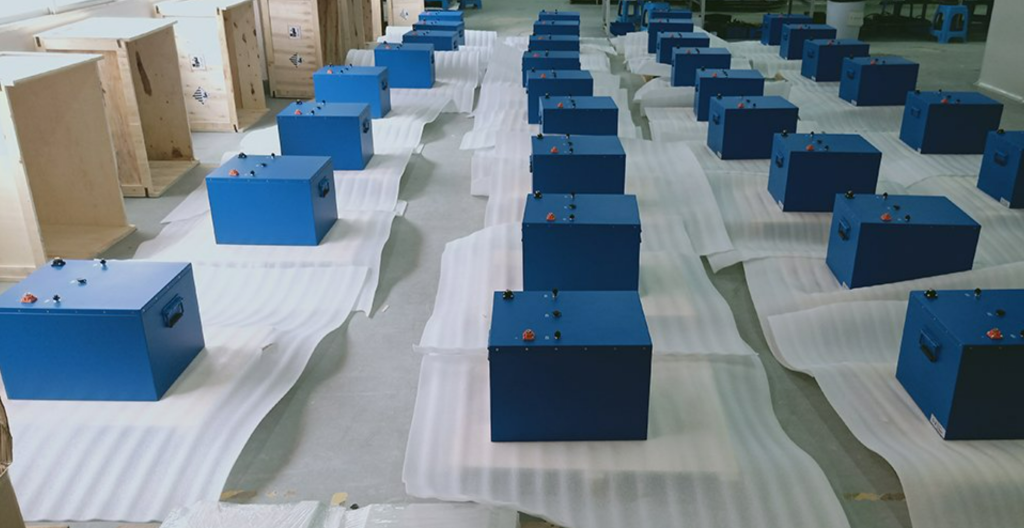
- 217kWh lithium battery storage
- Built-in MPPT solar inputs
- Integrated STS with 10ms on/off-grid switching
- Grid-connected and off-grid operating capabilities
- Coordinated solar, battery and utility grid energy management
The complete installation provides 150kW of rated power and 651kWh of nominal battery storage capacity.
Unlike systems requiring separately installed hybrid inverters and battery cabinets, each Recreen unit incorporates the inverter directly into the energy storage cabinet.
This integrated design simplifies equipment arrangement and provides a compact architecture for commercial solar-plus-storage applications.
3. 10ms STS Switching: Rapid Transition from On-Grid to Off-Grid Operation
One of the most important features of this project is the hybrid inverter’s integrated Static Transfer Switch (STS).
What Happens When the Utility Grid Fails?
Under normal conditions, the hybrid ESS operates in grid-connected mode, coordinating solar generation, battery storage and the utility grid.
If the grid supply is interrupted, the system is designed to detect the abnormal grid condition and transfer supported loads to off-grid operation through the integrated STS.
The specified switching time is 10 milliseconds (10ms).
This rapid transition helps reduce the duration of supply interruption and allows the battery system to continue supplying designated loads within the available inverter power and battery capacity.
When the utility grid returns, the hybrid system can transition back to grid-connected operation according to its control and synchronization requirements.
Why Does 10ms Switching Matter for Commercial Customers?
For commercial facilities, switching speed can be an important consideration when selecting a hybrid energy storage system.
A fast transfer function can help:
- Reduce interruption time during utility grid failures
- Support the continuity of designated commercial loads
- Improve operational resilience
- Reduce dependence on manual backup power switching
- Combine daily energy management and backup power functions in one system
The actual response of connected equipment depends on its tolerance to transfer interruptions, electrical configuration and operating conditions.
For highly sensitive equipment requiring strictly uninterrupted power, a dedicated UPS or additional power-conditioning solution may still be necessary.
By integrating STS functionality directly into the hybrid inverter, Recreen provides both energy management and rapid grid-to-off-grid switching within the same ESS architecture.
4. Why Choose 150kW BESS for a 90kW Load?
The customer has an existing electrical load of approximately 90kW.
From a simple power-sizing perspective, a smaller system might appear sufficient.
However, Recreen recommended three 50kW units to improve operational redundancy.
Normal Operation
Three hybrid ESS units operate together, providing a combined rated power of 150kW.
One Unit Becomes Unavailable
If one 50kW unit becomes unavailable, the two remaining units retain a combined rated power of 100kW.
This is above the store’s approximately 90kW operating load.
The design therefore provides a power-capacity margin intended to help maintain commercial operations if one unit is unavailable.
Actual continuity depends on the load at the time of the event, available battery energy, system control coordination, fault isolation and the electrical connection arrangement.
This project highlights an important principle:
Commercial energy storage should be sized not only for the current load, but also for reliability, redundancy and operational flexibility.
5. 250kWp Solar PV Directly Connected Through Built-In MPPT
The project integrates a 250kWp solar PV installation directly with the three hybrid energy storage systems.
Each 50kW hybrid inverter supports up to 100kW of PV input, providing a combined maximum rated PV input capacity of 300kW across the three units.
The installed 250kWp solar array connects directly to the hybrid inverters’ built-in MPPT inputs.
This creates a DC-coupled solar and battery storage architecture, without requiring separate PV inverters for the connected solar arrays.
Advantages of the Integrated MPPT Design
- Direct solar PV connection
- Integrated solar and battery energy management
- Reduced external power conversion equipment
- Simplified equipment configuration
- Flexible operation between solar, battery and grid power
The actual PV array distribution and string configuration are determined by the MPPT input voltage, current and power limits of each hybrid inverter.
For EPC contractors and commercial customers, this integrated approach provides a practical way to combine solar generation and battery storage within a modular system.
6. Customized Energy Management: Daytime Discharge and Nighttime Grid Charging
The customer’s electricity consumption is higher during daytime business hours and lower at night.
Recreen designed the operating strategy around this daily load profile.
Daytime: Solar PV + Battery Discharge
During the day, solar PV generation supplies electricity to the store.
The battery energy storage system also discharges according to the programmed operating schedule, helping support commercial loads and manage electricity consumption from the grid.
The hybrid inverter coordinates solar generation, battery discharge and utility grid power according to the system’s operating conditions.
Nighttime: Utility Grid Charging
At night, when the store’s electricity demand decreases, the battery storage system recharges from the utility grid.
The stored energy is then available for the following day’s operations.
The operating cycle can be summarized as:
Daytime: Solar PV + Battery Storage → Retail Store Loads
Nighttime: Utility Grid → Battery Storage
This approach allows the customer to manage stored energy according to business operating hours.
Where suitable electricity tariffs apply, nighttime grid charging may also create opportunities for energy cost optimization.
Actual savings depend on local electricity rates, charging and discharging efficiency and the customer’s load profile.
7. Future Expansion: Solar + Storage + EV Charging
The customer’s long-term energy plan also includes EV charging infrastructure.
Several EV charging stations are already located near the retail store, and the customer plans to purchase additional battery storage equipment to support future charging expansion.
As charging demand increases, energy storage can help manage peak power requirements, coordinate solar generation and support charging operations within the available electrical infrastructure.
A future integrated configuration could include:
Solar PV + Hybrid BESS + Retail Store Loads + EV Charging Stations
Additional battery capacity and power conversion equipment would be selected based on charger ratings, simultaneous charging demand, grid connection limits and site operating requirements.
The current installation therefore provides a starting point for future energy infrastructure development.
8. Key Project Highlights
10ms On/Off-Grid Switching
Integrated STS functionality enables rapid transfer between grid-connected and off-grid operation for supported loads.
150kW/651kWh Modular Hybrid BESS
Three 50kW/217kWh units provide a flexible commercial energy storage configuration.
Redundancy-Focused System Design
A 150kW system was selected for an approximately 90kW commercial load to provide additional rated power and reduce reliance on a single unit.
250kWp Direct Solar PV Integration
Built-in MPPT inputs connect the solar PV installation directly to the hybrid energy storage system.
Customized Charging and Discharging Strategy
Solar PV and battery discharge support daytime operations, while the batteries recharge from the utility grid at night.
Integrated Hybrid Inverter Architecture
The hybrid inverter, STS functionality and battery storage are integrated into each ESS cabinet.
Future EV Charging Expansion
The customer plans to add battery storage capacity to support nearby EV charging stations.
Conclusion: A Commercial BESS Designed for More Than Energy Storage
This Jordan project demonstrates how a commercial battery energy storage system can address multiple business requirements through one integrated solution.
For a retail store with an approximately 90kW electrical load, Recreen supplied a 150kW/651kWh modular hybrid BESS integrated with 250kWp of solar PV.
The system combines direct solar integration, scheduled battery operation, integrated STS functionality and a redundancy-focused design.
With a specified 10ms on/off-grid switching time, the hybrid inverter also provides a fast transfer capability that is important for commercial backup power applications.
Looking ahead, the customer’s planned EV charging expansion creates further opportunities for battery storage integration.
At Recreen Energy, we design commercial energy storage solutions around real operating requirements — from energy management and backup power to redundancy and future business growth.
Looking for a Reliable Hybrid Energy Storage Solution?
Recreen Energy provides customized commercial and industrial battery energy storage solutions for retail stores, commercial buildings, factories, solar installations and EV charging applications.
Our integrated hybrid ESS solutions can combine:
- Solar PV integration through built-in MPPT
- Battery energy storage
- Grid-connected and off-grid operation
- Fast STS switching
- Modular system configurations
- Customized charging and discharging strategies
- Future capacity expansion
Whether you are developing a solar-plus-storage project, upgrading commercial backup power or planning an EV charging installation, our engineering team can help design a solution based on your actual operating requirements.
Contact Recreen Energy to discuss your next C&I BESS project.
Website: https://recreen.com/